YZR M1: Understanding Yamaha’s MotoGP Balance Machine
The yzr m1 is best understood not as a single isolated motorcycle, but as Yamaha’s long-running MotoGP prototype line for the four-stroke era. From the beginning, the idea behind it was not brute-force spectacle for its own sake. It was balance, drivability, and the kind of chassis confidence that lets a rider keep speed alive through the middle of the corner.
That is why the YZR-M1 has always mattered technically. In a championship that increasingly rewarded acceleration, aero load, and stop-and-go violence, Yamaha kept refining a machine whose identity was tied to line quality, throttle connection, and the rider’s feel for the front and rear contact patches.
What defines it
The YZR-M1 is the Yamaha MotoGP prototype whose historical identity has been built around an inline-four engine, controllable torque delivery, and a chassis philosophy aimed at preserving corner speed rather than relying only on straight-line punch.
Jump to
What this breakdown covers
- Why the YZR-M1 has historically been read as Yamaha’s corner-speed prototype
- What the inline-four and crossplane logic changed in the way power reaches the rear tyre
- How chassis balance, braking posture, and rider feel shape the bike’s identity
- Why the M1’s strengths became harder to defend in a MotoGP field dominated by V4 acceleration
What the bike reveals before the stopwatch
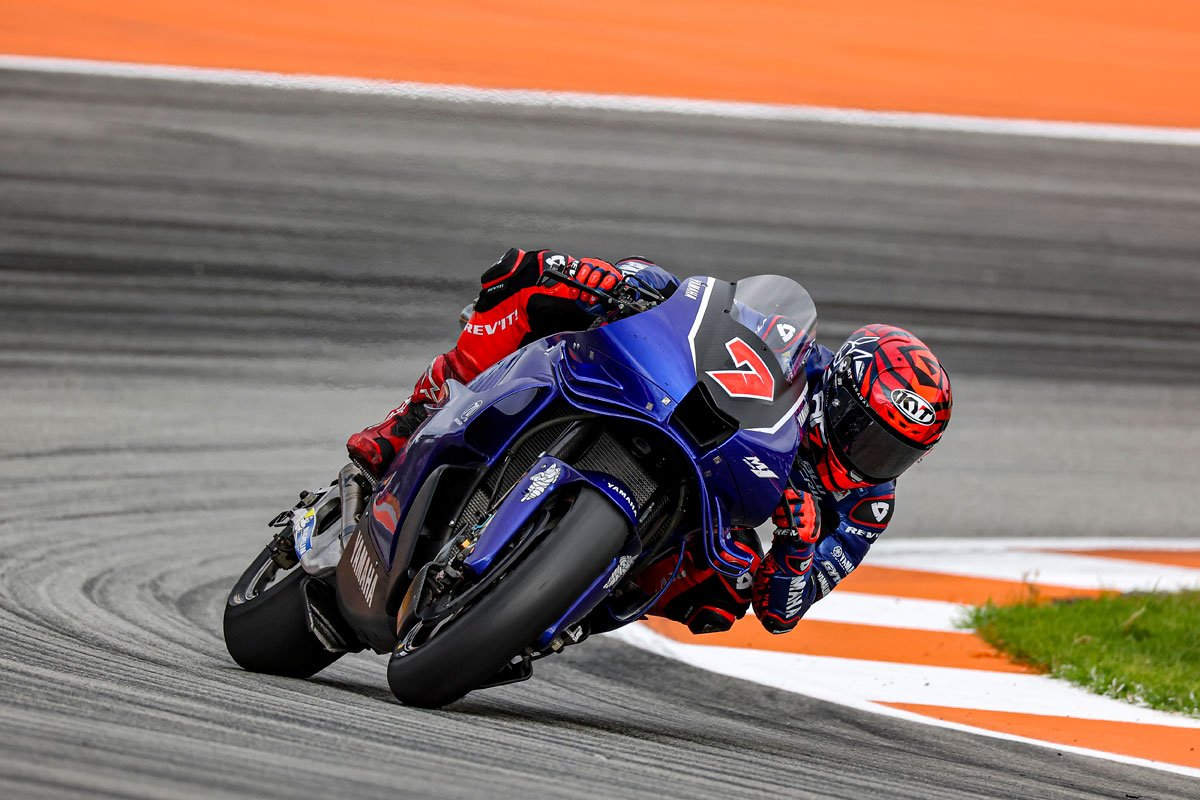
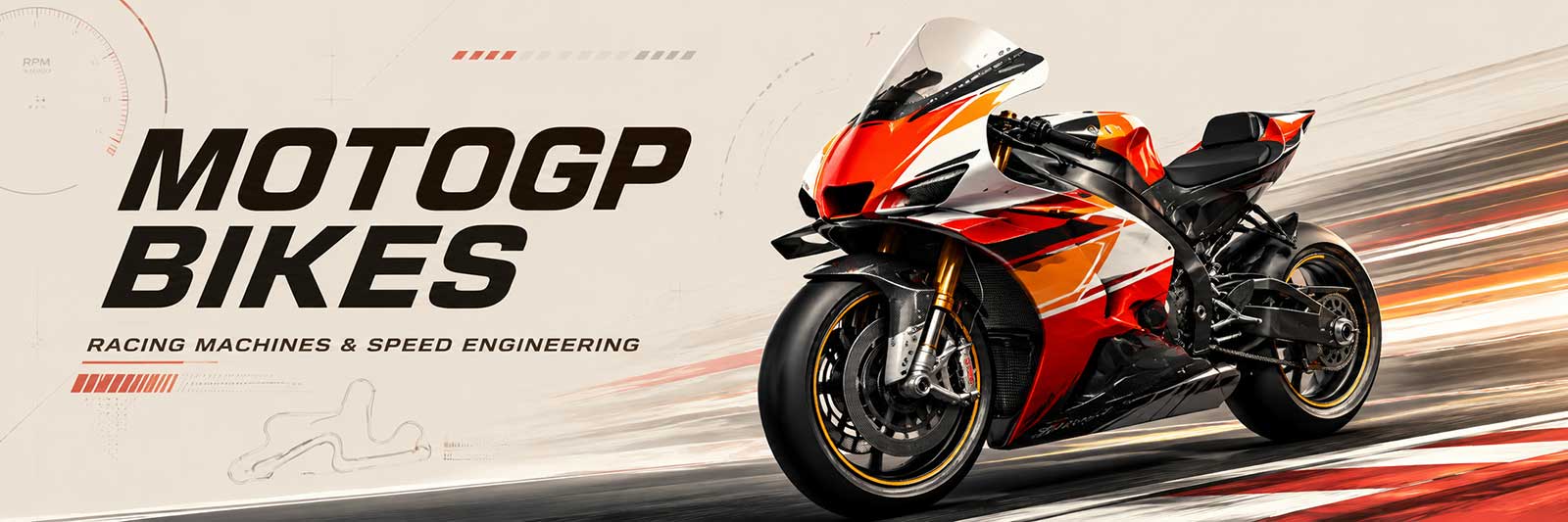
Even before lap time enters the discussion, the YZR-M1 reads differently from many rival MotoGP prototypes. The Yamaha line has long projected compactness and continuity rather than visual aggression alone. The packaging tends to suggest a motorcycle built to flow through phases of the corner instead of breaking the lap into disconnected episodes of extreme braking, sharp pivot, and drag-race exit.
That matters because on a MotoGP bike, visible layout usually reflects priority. A machine designed mainly around explosive rear-grip exit and straight-line recovery often advertises that intention in how it squats, how it accepts wheelie control, and how it uses aero support. The M1, by contrast, has historically looked like a bike that wants to stay composed between braking release and first pickup. That does not mean it lacks power. It means its identity has usually been tied to how useable that power feels once lean angle and tyre load are already high.
Engine layout, crank logic, and drive character
The key technical point is simple: for most of its MotoGP life, the yzr m1 has meant an inline-four Yamaha prototype, not a V4. Yamaha’s archives trace that line back to the first 2002 YZR-M1, already conceived as a compact inline-four four-stroke MotoGP racer built around drivability. In 2004, Yamaha introduced the crossplane-crank version, a decisive step because the development target was not only power, but more linear throttle response and a more natural engine-brake feel.
That crossplane logic is central to understanding the M1. Yamaha explained it in terms of reducing unwanted inertial torque effects so the rider feels combustion torque more directly and can read rear-tyre drive with less noise. In practical editorial terms, that means a calmer conversation between throttle hand and contact patch. The result is not magic grip, but a type of torque delivery riders often describe as easier to meter when they are already asking a lot from the rear tyre.
The gearbox matters too, even when public detail is limited. Yamaha’s official race specifications list the YZR-M1 as a six-speed MotoGP machine, and what matters on track is not just ratio count but how cleanly the bike can stay in its working zone without unsettling the chassis on the way back to power. On a bike whose identity depends on carrying speed, transmission behaviour is part of the same philosophy as the engine: keep the drive phase readable, not abrupt.
How the M1 carries itself through a lap
If the powertrain tells you why the M1 feels distinct, the chassis tells you where that distinctiveness actually pays off. Yamaha’s own specifications describe an aluminium twin-tube Deltabox chassis, and the company’s early M1 material repeatedly linked the project to overall balance and handling quality. That is the mechanical foundation for the M1 reputation: a bike that traditionally asks to be ridden with trust in mid-corner phase rather than with constant correction.
The best way to read the M1 on track is through transitions. It has often looked strongest when the rider can release the brake, commit to lean, and let the bike arc rather than force it into a violent point-and-shoot trajectory. This is exactly why the Yamaha-Ducati contrast was so often described as inline-four corner speed versus V4 straight-line speed. That shorthand is imperfect, but it captures something real about the M1’s competitive logic.
That same logic also explains the workload. A bike built around fluency can become demanding when the category shifts toward rear ride-height devices, aero dependence, and harder acceleration contests. Then the rider must protect momentum, braking timing, and tyre energy with even greater precision, because the machine’s advantage is not usually recovered by simply overpowering the straight.
Aero, brakes, and the control layer behind the feel
No modern MotoGP prototype can be understood without its control systems. On the M1, the important point is not to pretend we know every private setting, but to recognise the visible function: anti-wheelie behaviour, engine-brake strategy, and traction control all have to serve a bike whose historical value lies in composure and throttle continuity. Yamaha had already been developing electronic control around throttle action and engine-brake management in the early M1 generations, which fits the broader identity of a motorcycle trying to make rider inputs feel cleaner rather than merely more dramatic.
Braking and tyre load complete the picture. Yamaha’s published YZR-M1 specifications have listed Brembo carbon front brakes, Öhlins suspension, and the kind of top-level component set expected of a factory MotoGP machine. But the deeper point is behavioural: the M1 has often been discussed in terms of how it wants the rider to use the balance of the two tyres, especially under braking and release. Andrea Dovizioso’s remarks on adapting from Ducati to Yamaha made that clear: the bike asks for a different way of using tyre balance, and at first it did not feel “natural” to him under braking.
That is revealing. A motorcycle does not become distinctive only because of horsepower or aero appendages. It becomes distinctive when even an elite rider must reorganise his braking language to unlock what the chassis and tyre package are asking for.
How the project evolved as MotoGP changed
The YZR-M1 story is also a development story. The first 2002 bike arrived as Yamaha’s four-stroke MotoGP contender. By 2004, the crossplane crankshaft and uneven firing logic had redefined the engine’s feel and helped deliver a title-winning step. Later generations added further control sophistication, packaging revisions, and the constant search for more power without losing the machine’s signature readability.
What makes the M1 especially interesting is that its evolution was never just about chasing the same solution as everybody else. Yamaha stayed committed to the inline-four route for far longer than its V4 rivals, and that persistence became part of the bike’s identity. It also framed the competitive dilemma: preserve the qualities that made the M1 special, or move toward the architecture now favoured by the rest of the front-running field.
That dilemma ended up receiving a formal answer. MotoGP announced in November 2025 that Yamaha would switch the YZR-M1 to a V4 configuration for the 2026 season, explicitly closing the long inline-four chapter that had defined the bike’s historical DNA. So when most readers search for yzr m1, the most credible interpretation is still the famous inline-four Yamaha prototype line, even if its latest engineering direction has now changed.
The factual layer behind the bike
Some solid figures help anchor the analysis. Yamaha’s official race material lists the 2009 YZR-M1 as a liquid-cooled crossplane inline-four with over 200 horsepower, a six-speed transmission, an aluminium twin-tube Deltabox chassis, Öhlins suspension, and top speed in excess of 320 km/h. Earlier archives identify the 2002 machine as the first M1 four-stroke MotoGP racer, while later historical summaries connect the project to multiple premier-class titles.
Those numbers should be read carefully. They do not tell you everything about a MotoGP bike, but they do confirm the broad profile: this was never a soft or underpowered concept bike. The M1 had elite speed and factory-level hardware. Its identity came from where Yamaha chose to place emphasis within that performance envelope: drivability, balance, and the rider’s ability to interpret load changes with precision.
What makes this prototype worth studying
The reason the yzr m1 remains such a compelling MotoGP subject is that it shows another way a prototype can be fast. Not by denying power, aero, or electronics, but by organising them around clarity. The M1 has long been the case study in how an inline-four, crossplane-driven, balance-first philosophy can create a motorcycle that rewards corner speed, measured throttle use, and deep rider sensitivity.
That is also why the bike has felt so exposed when MotoGP trends moved against its natural strengths. A machine built around flow has less margin for chaos. But that vulnerability is exactly what makes the YZR-M1 technically interesting. It is not just a Yamaha race bike. It is one of MotoGP’s clearest demonstrations that how a prototype makes speed matters just as much as how much speed it can make.
Author: William L.