KTM RC16 MotoGP: What the KTM Prototype Really Is
The ktm rc16 motogp is not interesting because it is orange or because it entered the class later than some of its rivals. It matters because KTM chose to build a 1000cc MotoGP prototype around its own engineering instincts: a V4 engine, a seamless gearbox, Brembo brakes, Michelin tyres, and, most unusually, a steel-framed chassis philosophy paired with WP suspension instead of following the usual aluminium-frame route.
That is what makes the RC16 worth understanding properly. Once you stop describing it in vague “identity” language and start looking at the frame logic, the turning behaviour, the aero evolution, the electronics layer, and the speed it can generate, the bike becomes much clearer.
Quick answer
The KTM RC16 is a 1000cc V4 MotoGP prototype whose defining trait is not one isolated component but the way KTM combines strong engine performance, a seamless gearbox, aggressive aero development, Brembo-Michelin contact hardware, and a rare steel-frame/WP-suspension philosophy to produce a bike that has evolved toward better stopping, more natural turning, strong acceleration, and record-level top speed.
What you will learn here
- How the RC16’s V4 engine and seamless gearbox shape its acceleration and straight-line character
- Why the steel-frame and WP philosophy makes the bike technically unusual in MotoGP
- How KTM used chassis, swingarm, and aero updates to improve turning and front-end confidence
- What the Brembo, Michelin, and Marelli layers reveal about how the bike must be managed on track
Quick access
What defines the bike at first glance
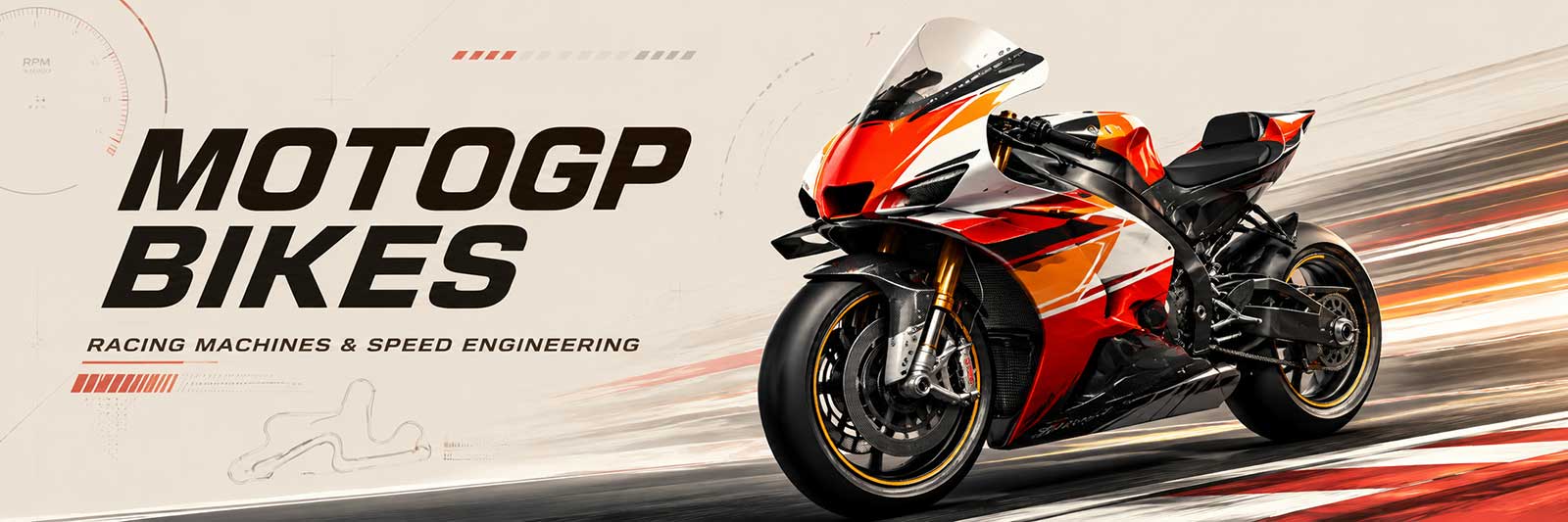
At first glance, the ktm rc16 motogp looks like a prototype built around mechanical purpose rather than elegance. The bodywork is compact, the aerodynamic package has become progressively more layered, and the machine gives the impression of being tightly packaged around front-end authority and acceleration control. That visual impression is not accidental: MotoGP’s own technical coverage has repeatedly linked KTM’s recent aero work to extra front-end margin and more stable behaviour, while KTM itself has long insisted that the project would follow its own frame-and-suspension philosophy rather than copy the rest of the grid.
That last point matters. Many MotoGP bikes can look superficially similar under current aero trends, but the RC16 was conceived with two fixed ideas from the start: a tubular frame and WP suspension. Even before you talk about lap time, that already tells you the RC16 is a bike born from KTM’s conviction that chassis feel and in-house response speed mattered as much as convention.
Engine, cylinders, gearbox, and power delivery
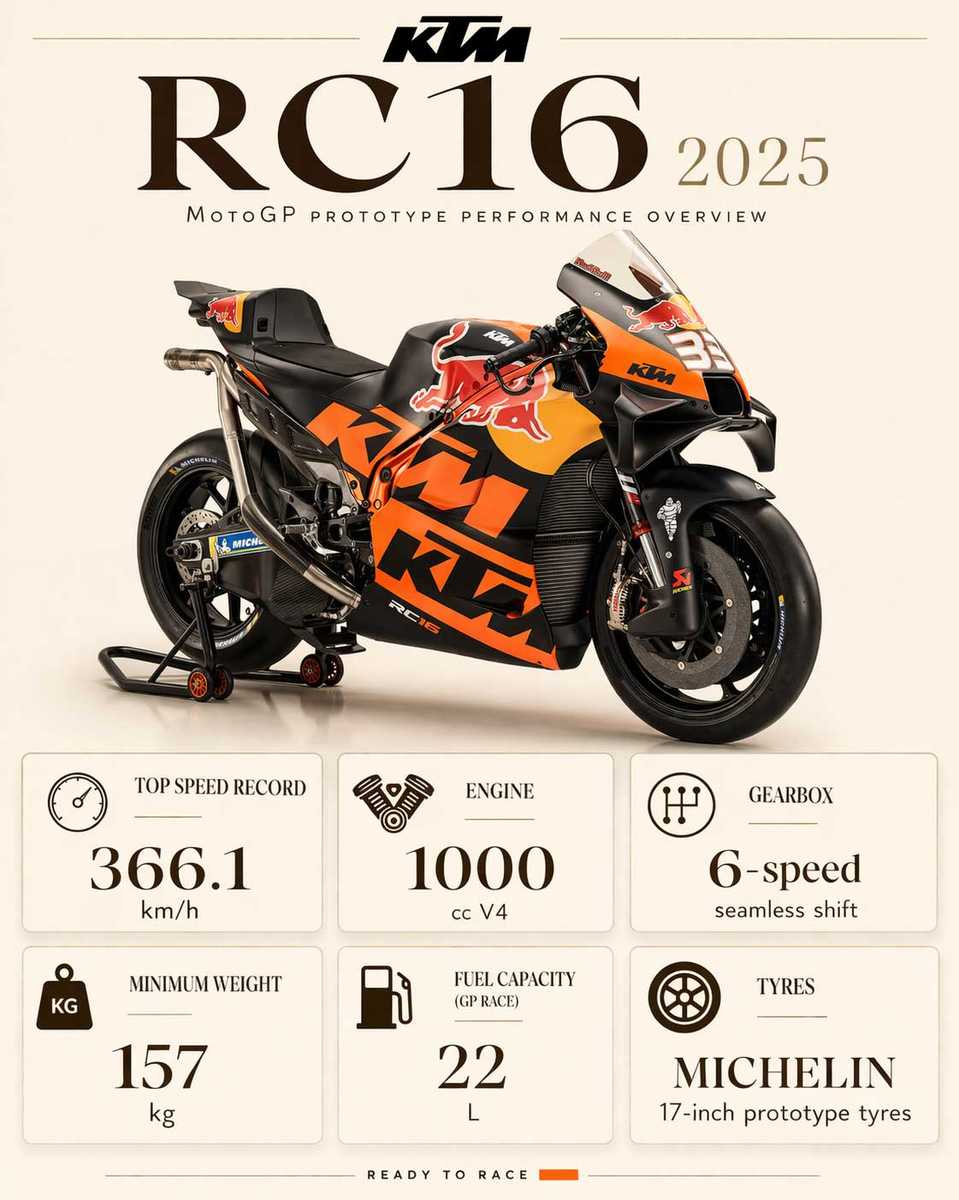
On hard facts, the RC16 is a 1,000 cc, four-cylinder MotoGP bike in V configuration, with pneumatic valve actuation, a seamless-shift gearbox, and official KTM-listed power of 265 hp+ with an 18,500 rpm rev limit. KTM’s own technical sheet also lists Akrapovič exhaust hardware and a 340 km/h+ maximum speed figure, which already places the bike in the expected performance territory of the modern premier class.
But the RC16’s real power-delivery story is not a brochure number. It is that the bike has repeatedly shown itself capable of genuine straight-line violence without becoming a one-dimensional dragster. KTM’s MotoGP programme now holds the official outright top-speed record at 366.1 km/h, first set by Brad Binder in 2023 and later matched by Pol Espargaró in 2024, which tells you the engine and aero package can produce elite terminal speed when the circuit allows it.
Public documentation is much thinner on the RC16’s exact crankshaft philosophy and deeper engine internals, so it is better not to pretend certainty there. What can be said with confidence is that the bike’s mechanical package is built to let riders exploit very high power with a seamless gearbox and a modern electronics layer, which means the discussion quickly shifts from “how much power?” to “how controllably can that power be delivered while the bike is still finishing the corner?”
Chassis, agility, and on-track behaviour
This is where the RC16 becomes most recognisable. KTM chose a steel tubular trellis main frame for the project and publicly described a tubular frame and WP suspension as non-negotiable starting points. In a class where aluminium twin-spar thinking has long dominated, that alone makes the RC16 conceptually different.
The more important point is how KTM developed that philosophy. MotoGP’s technical reporting from 2021 linked a major RC16 chassis step to better stopping and turning, with Brad Binder explicitly saying the new frame gave the bike more “natural turning.” Miguel Oliveira also described that frame as gentler on the tyre over race distance. Those are not vague compliments: they suggest KTM was chasing a bike that needed less force to finish the arc, used less lean-time on the edge of the tyre, and could move onto a bigger contact patch earlier on exit.
That is a meaningful clue to how the RC16 has evolved. Earlier KTM MotoGP bikes were often described as physical and demanding. The later development direction seems to have been about preserving the bike’s braking and acceleration strengths while reducing the effort required to get it stopped, rotated, and driven out cleanly. New swingarm work also became part of that search, with MotoGP’s 2022 technical round-up highlighting the importance of a revised swingarm that had been in development for some time before becoming a full-time race part.
Fairing, aerodynamics, and visual logic
The RC16’s bodywork should be read as working hardware, not decoration. MotoGP’s technical coverage shows KTM adding larger upper wings, sidepod wings, updated fairing details, and later revisions depending on circuit demand. Riders reported that some of these aero steps gave them more margin for error on the front end, which is a very revealing phrase in modern MotoGP: aero is not only about top speed and wheelie suppression, it is also about stabilising the bike in braking and in the first part of corner entry.
That is why the RC16’s aero story is more interesting than “it has winglets.” KTM has chased front-end support and stability while still preserving enough efficiency to become the bike attached to the current top-speed record. When a prototype can generate real downforce benefits without sacrificing straight-line potency, that usually tells you the bodywork and total package are working together rather than fighting each other.
Electronics, anti-wheelie, and control systems
KTM’s official RC16 technical sheet lists a Magneti Marelli electronics system with drive-by-wire, engine braking, quickshifter, traction control, and wheelie control. MotoGP’s own electronics explainers add the bigger context: the championship uses a standardised Marelli ECU and unified software, so factories do not win by hiding exotic secret ECUs. They win by calibrating the common electronic toolbox better around their engine character, tyre behaviour, and rider preference.
For the RC16, that means the electronics are there to civilise a very aggressive mechanical package. Traction control helps meter rear-wheel spin on exit, wheelie control helps stop acceleration from becoming unusable, and engine-braking management is crucial because a bike that attacks the braking zone hard also needs a rear end that stays calm when the throttle closes. KTM test comments from early development already referenced work on traction and wheelie control, which fits that reading.
One useful distinction: not everything that lowers the bike is “electronics.” MotoGP’s current ride-height and holeshot systems are mechanical devices, with the rear ride-height device usable during the race and the front holeshot device restricted to the start. So when you watch an RC16 squat and launch, part of that is electronic torque management, and part of it is mechanical chassis manipulation.
Brakes, tyres, wheels, and mechanical contact with the track
The RC16’s official specification lists Brembo braking components, carbon front discs in 320 mm and 340 mm options, Michelin 17-inch tyres, and forged magnesium wheels. That is the contact layer that translates everything else into lap time. Brembo’s own MotoGP material explains why carbon discs dominate the class: they reduce unsprung mass, tolerate the heat loads of premier-class braking, and offer riders multiple disc choices depending on circuit demand.
Tyres are just as decisive. KTM itself describes MotoGP as moving with spec Michelin rubber, and the championship confirmed Michelin as sole supplier through 2026. That matters because the RC16’s development language in recent years has repeatedly pointed toward making the bike calmer on the tyre, more natural in turning, and more supportive at the front. In other words, KTM has not simply been trying to add grip; it has been trying to use the tyre better.
The factual details that help explain it
Some hard reference points help anchor the editorial picture. KTM publicly committed to the MotoGP project in 2014, the RC16 was already testing by 2015, and MotoGP documented its path to the grid during 2016. KTM then entered the class full-time in 2017, took its first podium in 2018, and scored its first MotoGP win in 2020 at Brno.
The technical sheet for the RC16 lists 1,000 cc displacement, V4 architecture, pneumatic valves, a seamless gearbox, steel tubular trellis main frame, WP suspension, Brembo brakes, forged magnesium wheels, and Marelli electronics. KTM’s current MotoGP page adds the wider competitive context: the RC16 has taken victories in 2020, 2021, and 2022, holds the all-time top-speed record at 366.1 km/h, and 2026 is the final year of the current 1000cc MotoGP rulebook before the move to 850cc in 2027.
Why this machine feels distinctive
The RC16 feels distinctive because its differences are structural, not cosmetic. KTM did not simply paint a conventional MotoGP bike in orange. It committed to a steel-frame and WP-suspension philosophy, built the project around a V4 with seamless-shift performance, kept refining its aero to support the front and control acceleration, and then developed the chassis until riders began talking in very concrete terms about improved stopping, turning, and tyre usage.
That combination gives the RC16 its specific flavour. It is a bike that has shown it can be brutally fast in a straight line, yet its more interesting progress has come from becoming easier to rotate, less punishing on the tyre, and more complete over race distance. That is the difference between a loud prototype and a mature one.
Why it still matters
The ktm rc16 motogp still matters because it proved that a factory could enter the class with an unconventional chassis philosophy, win races, and end up holding the speed record instead of merely surviving. In MotoGP, where imitation is always tempting, the RC16 is one of the clearest recent examples that a machine can remain recognisably different and still become fully credible at the front.
Author: Eric M.